What to Do If Your Budget Flight from Singapore Gets Delayed
Flight delayed at Changi? Here is the exact sequence, from verifying the delay to claiming compensation and protecting your onward connections.
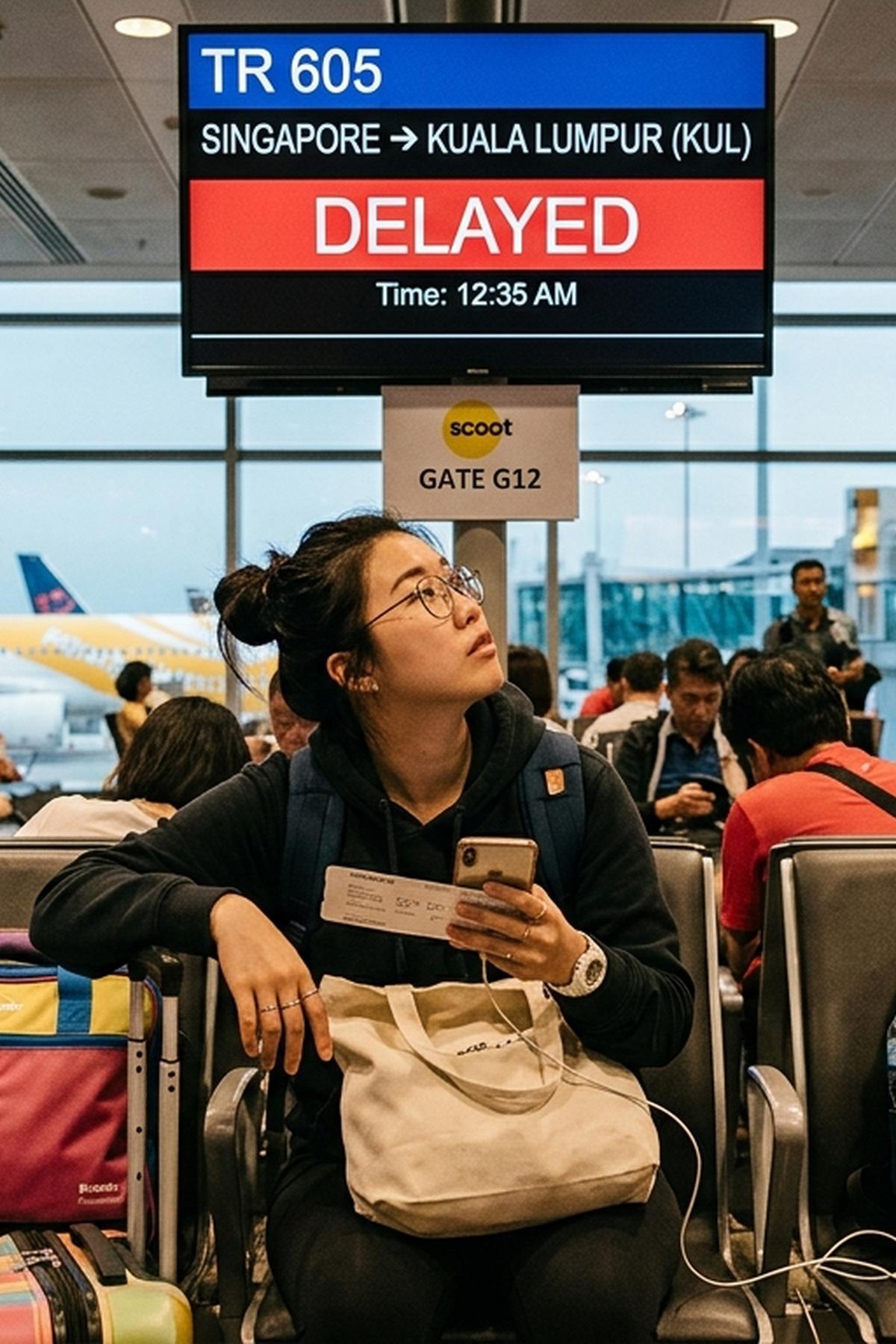
Your departure board just flipped to "Delayed" and your budget airline's app is giving you nothing useful. The queue at the service counter is already six deep. You have a connecting flight booked separately, and your travel insurance terms and conditions are somewhere deep in your inbox. This is the situation nobody prepares for, but it happens at Changi more than any frequent flyer would like to admit. Here is the practical sequence that keeps you ahead of it.
Delay Situation in Brief
Before you join any queue or make any call, confirm the delay is real and get a time estimate. From there, your rights depend on the airline's own conditions, since Singapore has no government-mandated compensation law equivalent to Europe's EC 261/2004. Budget carriers set their own thresholds. Knowing that upfront saves you from arguing for entitlements that simply do not exist here, and helps you focus on what does.
Confirm the Delay Before You Move
The first thing to do is not call the airline. It is not rush to the counter. It is to find out exactly what is happening with your flight right now. That sounds obvious, but most people skip this step and waste an hour standing in a line for information they could have had in 30 seconds.
A real-time source that pulls live status data is far faster than any airline hotline. Taking a moment to check flight delay status through an independent flight tracker tells you whether the inbound aircraft is on the ground, whether the delay is weather-related or mechanical, and what the current estimated departure is. That single piece of information determines everything that follows: whether you need to rebook urgently, whether you have time for a proper meal at Terminal 3, or whether the disruption is short enough that heading to the airport still makes sense.
Budget airlines rarely send proactive updates in the early stages of a disruption. Scoot, AirAsia, and Jetstar Asia all have apps that will eventually push a notification, but "eventually" can mean 90 minutes into a three-hour delay. An independent status check gives you a meaningful head start on everyone else in your gate area.
Understanding Your Rights Under Singapore's Air Travel Rules
Singapore does not have a statute that forces budget airlines to pay fixed compensation for delays, the way EC 261/2004 does for European carriers. There is no SGD 600 payout waiting for you after a three-hour delay out of Changi. This is worth understanding clearly before you spend energy demanding it.
What you do have is the airline's own Conditions of Carriage, which every carrier operating out of Changi is contractually bound by. These documents spell out what the airline owes you when a departure is delayed: typically meal vouchers after a certain number of hours, hotel accommodation for overnight delays, and the right to a full refund or rebooking if the delay crosses a defined threshold. Scoot's threshold for a significant delay is generally three hours. Jetstar Asia and AirAsia have broadly similar provisions, though the exact triggers and fare class conditions vary.
The Civil Aviation Authority of Singapore provides the framework for how airlines should handle passenger grievances and complaints, but enforcement of compensation is largely driven by what each airline has contractually promised in its own Conditions of Carriage, rather than a government-mandated payout scale.
If the delay is caused by a technical fault or an operational issue within the airline's control, you have a stronger case for meal vouchers, accommodation, and rebooking options. If it stems from extraordinary circumstances such as severe weather, airspace restrictions, or a security incident, the airline's liability narrows considerably under both their own policies and the Montreal Convention.
What to Actually Ask For at the Counter
Once you know the delay length, your first priority at the counter is getting the airline to put something in writing. Request a delay certificate or a disruption letter. This document is essential for any insurance claim later. Airlines do not always volunteer it, but they are required to provide it upon request. Get the agent's name and note the time.
For delays of two hours or more, ask specifically for meal vouchers. Most budget carriers will provide these for delays they classify as significant, though the definition varies. For delays likely to run overnight, push for hotel accommodation. Some budget airlines will offer a lower-cost hotel option. If you choose to arrange your own accommodation, keep every single receipt and confirm in writing that the airline has authorised the expense before you check in. Without that confirmation, reimbursement becomes extremely difficult to recover later.
Do not accept a rerouting through a different airline without confirming that your checked baggage will follow the same revised itinerary and that your new boarding pass covers all remaining legs. Budget carriers occasionally rebook passengers on a partner carrier for one leg and leave them to sort out the rest at the destination airport independently.
Protecting Onward Connections on Separate Tickets
This is where budget travel gets genuinely costly. If you booked your Singapore departure on Scoot and your next flight on a completely separate booking with another carrier, that second airline has no obligation to hold the flight or rebook you at no cost. They treat a missed connection on a separate ticket exactly as they treat a no-show, and the default outcome is that you forfeit the fare.
The only real protection in this scenario comes from travel insurance with a missed connection benefit, or from purchasing a connection guarantee at the time of booking. Some online travel agencies offer this product for a small added fee. It is worth considering on itineraries where the layover is under three hours and the first leg is a budget carrier with a historically uneven on-time record on that route.
If you do miss an onward connection because of the first flight's delay, file your claim with both the airline (for the delay certificate) and your insurer as immediately as possible. Most travel insurance policies have a strict notification window, often 24 to 48 hours, for missed connection claims. Missing that window results in a rejected claim regardless of how legitimate the underlying disruption was.
Budget Routes Out of Singapore with the Most Disruption
Not all routes carry equal delay risk out of Changi. Short-haul routes to secondary airports in Indonesia, including Lombok (LOP) and Makassar (UPG), see above-average disruption rates due to convective weather patterns and more limited ground handling capacity at the destination. Routes to Clark (CRK) in the Philippines and Don Mueang (DMK) in Bangkok also show higher delay frequencies compared to major hub routes like Kuala Lumpur or Hong Kong.
The Northeast Monsoon season between November and January pushes delay rates up noticeably for routes through the South China Sea corridor. Typhoon activity from July through October affects Philippine routes in particular. Booking red-eye or early morning departures on these routes typically reduces your exposure, since overnight and dawn flights carry fewer cascading delays accumulated from earlier rotations in the day, though they carry their own tradeoffs for rest and connection timing on arrival.
When Travel Insurance Actually Pays Out (and When It Does Not)
Travel insurance covers flight delays in a narrower set of circumstances than most buyers assume. Most standard policies require a minimum delay of six hours before the delay benefit triggers, and some budget-tier policies set the threshold at eight or even twelve hours. A two-hour delay, even one that causes a missed connection, will not produce a payout on a standard plan.
Coverage also typically excludes delays caused by strikes if the industrial action was announced publicly before your policy start date, and excludes delays caused by force majeure events such as volcanic ash clouds or declared natural disasters. The coverage that most commonly pays out covers delays caused by mechanical faults, crew shortages, or operational problems that fall squarely within the airline's control.
Annual multi-trip plans from Singaporean insurers generally offer better value for frequent budget flyers than per-trip purchases, particularly if you take four or more regional flights per year. The per-trip cost drops significantly on an annual plan, and the missed connection benefit is usually more generous than what single-trip policies carry. Compare the policy exclusions carefully rather than just the headline premium.
The Difference Between Hoping for Help and Being Ready for It
Budget airlines price the expectation of disruption into their model. The low fare reflects a lower service baseline, and that includes how delays are handled. Flying Scoot or AirAsia because the fares are real and the savings are real is a completely rational choice. The cost is that when things go wrong, the recovery experience will not feel like a full-service carrier.
The passengers who come out of a delay with the least damage are the ones who confirmed the situation early through a live source, carried their documents, had their insurer's claims line saved in their phone contacts, and knew the exact clause in the airline's Conditions of Carriage before they reached the counter. That preparation takes about fifteen minutes before any trip. Against a three-hour disruption at Changi, the return on that time investment is hard to argue with.