Budget Flights from Singapore and the Extra Costs That Change the Deal
Compare return flights from Changi with itemised budgets for bags, seats, transfers and data, plus a checklist to spot fares that cost more overall.
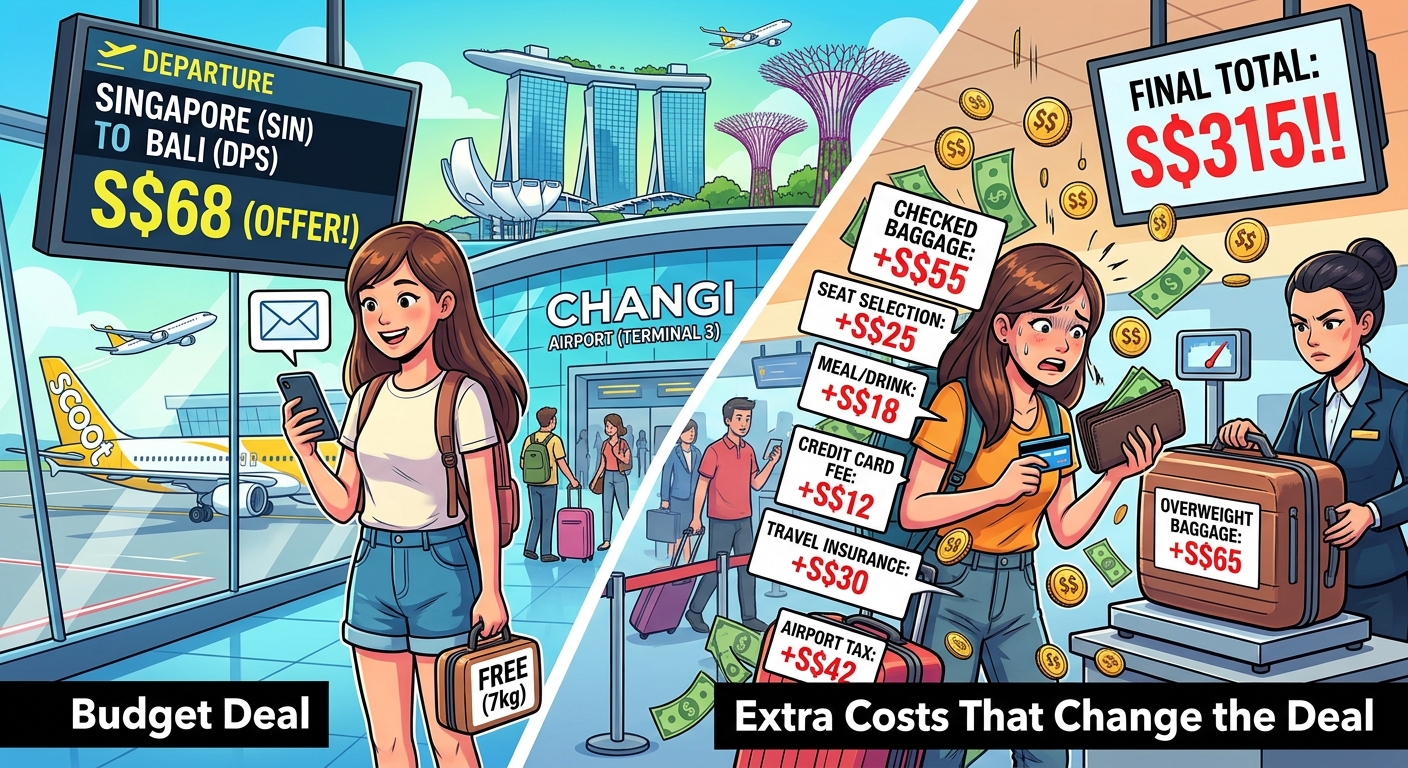
A S$129 return flight looks brilliant until the checkout total reaches S$219 and the arrival time adds a taxi ride. For Singapore travellers squeezing a regional break into a weekend, these costs can swallow the saving before the holiday begins. The useful comparison starts with your front door, follows you through Changi and your destination airport, and ends when you get home. That is where a cheap fare either earns its place or loses its advantage.
The Price That Counts: Compare return airfare, baggage, seats, airport transfers and mobile data for the same traveller and trip length. A lower fare can lose once you add the services you need or the transport its timing requires. The examples below use illustrative Singapore-dollar budgets, rather than live offers. Replace each figure with your checkout price and transport quote, then judge the saving against the hours and convenience you give up.
Build One Return-Trip Budget Before Comparing Airlines
Start with a consistent shopping basket. A three-night Bangkok trip with a checked suitcase is a different purchase from a backpack-only weekend in Kuala Lumpur. Comparing their headline fares tells you little about value.
For each flight option, record the return airfare including compulsory taxes and fees. Add baggage for each direction, any seats you intend to purchase, transport at both ends and connectivity for the full stay. Include a payment or booking charge if it appears at checkout.
Use the same dates, passenger count and destination area. A fare landing at one Bangkok airport cannot be assessed properly against another without checking the journey to your actual hotel. The distance on a map is only part of it. Arrival time and available transport matter too.
Keep accommodation and everyday meals outside this flight comparison when they are identical. Add them back if the flight creates an extra expense, perhaps an additional hotel night before an early departure.
Three Regional Trips Show Where the Saving Goes
The following examples are worked budgets for one adult travelling from Changi and returning after three nights. They are hypothetical planning figures, not advertised fares, airline fee quotes or current transport tariffs. They show how to calculate a decision using prices you collect yourself.
Each transfer allowance covers the return journey. “Singapore transfers” means home to Changi and back. “Destination transfers” means the arrival airport to the accommodation and back. Seat and baggage figures cover both flights unless stated otherwise.
Illustrative Return-Trip Costs From Changi
| Cost Per Traveller | Bangkok: Lower Fare | Bangkok: Inclusive Fare | Kuala Lumpur: Light Packing | Bali: Checked Bag |
|---|---|---|---|---|
| Return airfare | S$150 | S$225 | S$110 | S$180 |
| Checked baggage | S$60 | Included | S$0 | S$70 |
| Selected seats | S$24 | Included | S$0 | S$28 |
| Singapore transfers | S$36 | S$6 | S$6 | S$36 |
| Destination transfers | S$40 | S$40 | S$30 | S$40 |
| Mobile data allowance | S$10 | S$10 | S$10 | S$10 |
| Total | S$320 | S$281 | S$156 | S$364 |
The Bangkok comparison is the useful head-to-head. Its inclusive fare starts S$75 higher but finishes S$39 cheaper. Baggage and seats erase the initial advantage. A further S$30 difference in Singapore transport widens the gap. This example assumes the inclusive ticket actually contains the required bag and seat selection, which must be checked before booking.
The Kuala Lumpur example shows when a stripped-back ticket can work. The traveller stays within the included cabin allowance, accepts an allocated seat and uses public transport in Singapore. There is no reason to buy extras simply because they appear during checkout.
The Bali budget shows how far a headline figure can sit below the trip total. Its S$180 airfare becomes S$364 after the listed costs. That does not make it poor value. It means S$364 is the amount to compare with another suitable itinerary.
Baggage and Seats Can Reverse the Fare Ranking
Pack on paper before buying the ticket. Count clothes, toiletries, footwear, electronics and likely purchases. Then weigh the actual bag. A small suitcase can still exceed the weight allowance, and a laptop bag may count towards the combined limit.
Read the baggage terms for the fare you are purchasing. Check the permitted number of pieces, dimensions and weight. Do not assume every budget airline uses the same allowance or that a larger cabin allowance includes checked luggage.
Shopping can also change the return journey. If you need checked baggage only on the way home, price that arrangement separately. For two people sharing one checked suitcase, confirm the airline's rules before assigning the allowance to a single booking.
Seat selection deserves its own decision. A solo traveller who accepts an allocated seat may spend nothing. A couple wanting adjacent seats should price both passengers on both flights. Families should read the airline's seating policy instead of assuming that either free allocation or paid selection guarantees their preferred arrangement.
Budget Mobile Data Across the Whole Stay
Connectivity is a small line in the budget, but it should still be deliberate. Compare your Singapore mobile provider's roaming option with an eSIM before deciding what to spend. Check device compatibility, destination availability, data allowance, validity and activation instructions for the specific option you are considering.
The S$10 figures in the examples are placeholders. They are not a quoted price from any provider. Replace them with the amount payable for your dates and expected usage.
Maps, messages and transport bookings need a different budget from video streaming or laptop tethering. Check whether hotspot use is permitted if you plan to share data. Also check whether your existing mobile subscription already includes usable roaming data for the destination.
Keep access to your Singapore number in mind if you need banking messages or calls. A data connection and a working voice or SMS service are separate requirements. Read your home provider's charging rules before departure.
Flight Timing Changes the Transfer Bill
A late arrival can move you from a planned train journey to a taxi. An early departure can do the same before you even reach Changi. Check transport operating hours against the time you need to travel, including check-in, immigration, baggage collection and the journey to the station or pickup point.
Terminal logistics deserve a few minutes of attention too. Changi Airport's official terminal transfer guidance confirms that Terminal 4 is served by complimentary shuttle buses. Allow time for that connection if your route through the airport requires it.
At your destination, price transport to the accommodation address. A central railway station is not your final stop if the hotel requires another paid journey. For a late flight, check whether your preferred service will still be available after a realistic arrivals buffer.
Shared transport needs careful arithmetic. If two travellers share a S$40 car, the cost is S$20 each. If one traveller takes it alone, the full S$40 belongs in that person's budget. Keep this consistent across every option.
Calculate How Much Extra Fare Is Worth Paying
You do not need a complicated spreadsheet. Use this sequence once you have two suitable flights open:
- Subtract the cheaper return airfare from the higher airfare to find the initial price gap.
- Total the baggage, seats, transfers and data required for each option.
- Compare the final totals, then assess whether the remaining saving justifies the less convenient timing.
In the Bangkok example, the lower fare brings S$170 in additional costs. The inclusive option brings S$56. That S$114 difference is larger than the S$75 airfare gap, leaving the inclusive option S$39 ahead.
Run a second calculation if your preferences are flexible. Remove paid seats if you are happy with allocation. Remove checked baggage only if your packed belongings fit the included allowance. These changes can restore the cheaper ticket's advantage.
Time deserves a separate judgement. A small cash saving may be attractive for a relaxed week away. It may feel much less useful when it removes half a day from a two-night break or leaves you exhausted before work.
Before You Book, Check the Fare Still Wins
Use this checklist at the final payment screen, with both itineraries priced for the same needs. Save the fare conditions and your cost notes so you can see exactly what you bought.
- Return price: Have you included both flights, compulsory taxes and any checkout charges?
- Baggage: Does your packed bag meet the allowance on each flight, including expected purchases?
- Seats: Have you priced your actual seating preference for every passenger and direction?
- Changi access: Can you use your planned transport at the required time, with any terminal connection allowed for?
- Destination transfers: Does the budget reach your accommodation and return to the correct departure airport?
- Mobile data: Have you checked the payable price, compatibility, validity and activation requirements?
- Shared costs: Have you divided car fares and other shared expenses consistently?
- Final saving: Is the remaining price advantage enough for the timing and convenience you are accepting?
Read next
-
 What a Budget Weekend Trip from Singapore to Bangkok Actually Costs
A real all-in cost breakdown of a budget Bangkok weekend trip from Singapore — flights, baggage fees, transfers, accommodation, and the costs most travellers miss.
-
 Flights and Full Trip Costs for a Hong Kong Weekend from Singapore
Full cost breakdown for a Hong Kong weekend from Singapore. Flights on Scoot, Jetstar, and Cathay Pacific, plus transport, accommodation, and eSim tips.
-
 What to Do If Your Budget Flight from Singapore Gets Delayed
Flight delayed at Changi? Here is the exact sequence, from verifying the delay to claiming compensation and protecting your onward connections.